Mizzou’s Center for the Humanities is strengthening interdisciplinary scholarship while fostering collaboration between faculty and students. Through the Center’s Cross-Generational Research Initiative (CGRI), the Center is supporting dynamic humanities research and providing undergraduate and graduate students with immersive hands-on experience in research, creative activities, project management, and collaborative problem-solving.
The CGRI sponsored the following projects this year:
“The Age of All Women: The Becoming of Younousse Seye”
The Center for Humanities CGRI grant supported research, production, and mentorship for the documentary film, “The Age of All Women: The Becoming of Younousse Seye.” Led by Merve Fejzula, assistant professor of history, the project highlights the remarkable career of Younousse Seye, one of Senegal’s first contemporary artists. The grant funded trips to Chicago, Dakar, Paris, and Washington D.C. The research team’s seven-minute film debuted in the international exhibition “Survival Kit” at the Musée Théodore Monod in Dakar. In addition to serving as production assistants, Mackenzie Tor, a doctoral candidate in history, and Kristyna Le, an undergraduate student in history, are co-authoring an article about Seye for The Metropolitan Museum of Modern Art’s blog. Le and Marion Johnson, who also was involved in the project, are pursuing their graduate studies in the field of public history.
Discovering ancient Amazonian archaeological sites
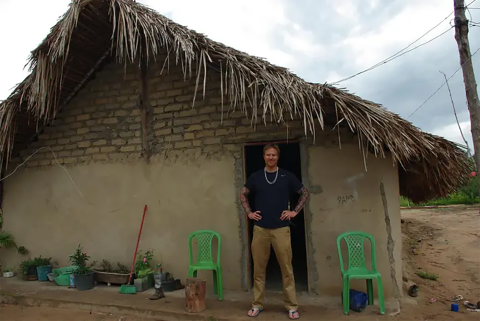
A research team led by Robert Walker, professor of history, conducted archaeological fieldwork in Southwest Amazonia. The team included Jeffrey Ferguson, associate professor of history; Jim Elghammer, a graduate student in anthropology; and Zachary Smith, an undergraduate student in geological sciences. Their research has been highlighted in a paper, a conference proceeding led by undergraduate student Albert Zhou, a meeting presentation conducted by postdoctoral student Jonathan Paige, and two poster presentations at the University of Missouri’s Undergraduate Research Day. The funding also helped further develop the team’s website.
The broad scope of the project, spanning archaeological fieldwork, digital humanities, and remote sensing, procured additional funding sources. The research team secured support from the PaleoWest Foundation, the Ellen and Charles Steinmetz Endowment for Archaeology (The Archaeological Institute of America), and a Fulbright Scholar Award. These funds provided additional fieldwork sessions and allowed them to showcase their student and postdoctoral training and website presence. The team also strengthened its application materials for funding opportunities from the National Endowment for the Humanities, Society for American Archaeology, Wenner-Gren Foundation, and the National Geographic Society.
Participatory Filmmaking with Refugee Newcomer Youth
With the support of the CGRI grant, Viviana Goelkel Garcia and Melissa Hauber-Özer facilitated participatory filmmaking workshops in spring 2024. Goelkel Garcia, assistant teaching professor, School of Visual Studies; and Hauber-Özer, assistant professor and co-director of qualitative inquiry, College of Education and Human Development; taught a service-learning course on collaborative filmmaking. They mentored undergraduate students in participatory research methods, project-based learning, and youth development. These students served as mentors during filmmaking workshops for refugee-background youth at the City of Refuge and low-income youth in the Moving Ahead Program. Community media center VidWest Studios hosted the workshops, providing access to instructional space and equipment. This partnership increased the reach of the project, encouraged the social integration of refugee-background youth, and secured additional resources for production. Evie Grasinski, an undergraduate in film studies, collected youth-produced content in spring 2024 and began post-production with Goelkel Garcia in fall 2025. The rough cut is scheduled to be completed by the end of June 2026.
Adapting Kafka
Carsten Strathausen, professor of German and English, worked closely with Mizzou students and Verena Kick, assistant professor of German at Georgetown University, on “Adapting Kafka,” a digital humanities project. Hans Estwanick and Otelia Mahurin, undergraduate students studying German, assisted with web design and data collection and management. They also conducted historical and hermeneutic research into distinct artists, media, and genres under Strathausen’s supervision. The team discussed individual adaptations and designed new metadata for comparison across rubrics. Andrei Kazakov, who is pursuing his graduate degree in English, designed computational codes that allowed the researchers to compare different editions of Franz Kafka’s works, studying features such as sentence length and use of subjunctives.
In addition to gaining research experience, Otelia Mahurin, undergraduate student in German Studies; and Andrei Kazakov, graduate student from the Department of English, gave a 15-minute presentation about their research contributions during an international Kafka conference at Georgetown University. Strathausen delivered three invited lectures and two conference papers in Canada, Germany, the United Kingdom, and United States. With Wenyi Shang, assistant professor in the College of Education and Human Development, Strathausen published a peer-reviewed article titled “Kafka’s Literary Style. A mixed-method Approach” in the Humanities online journal.